

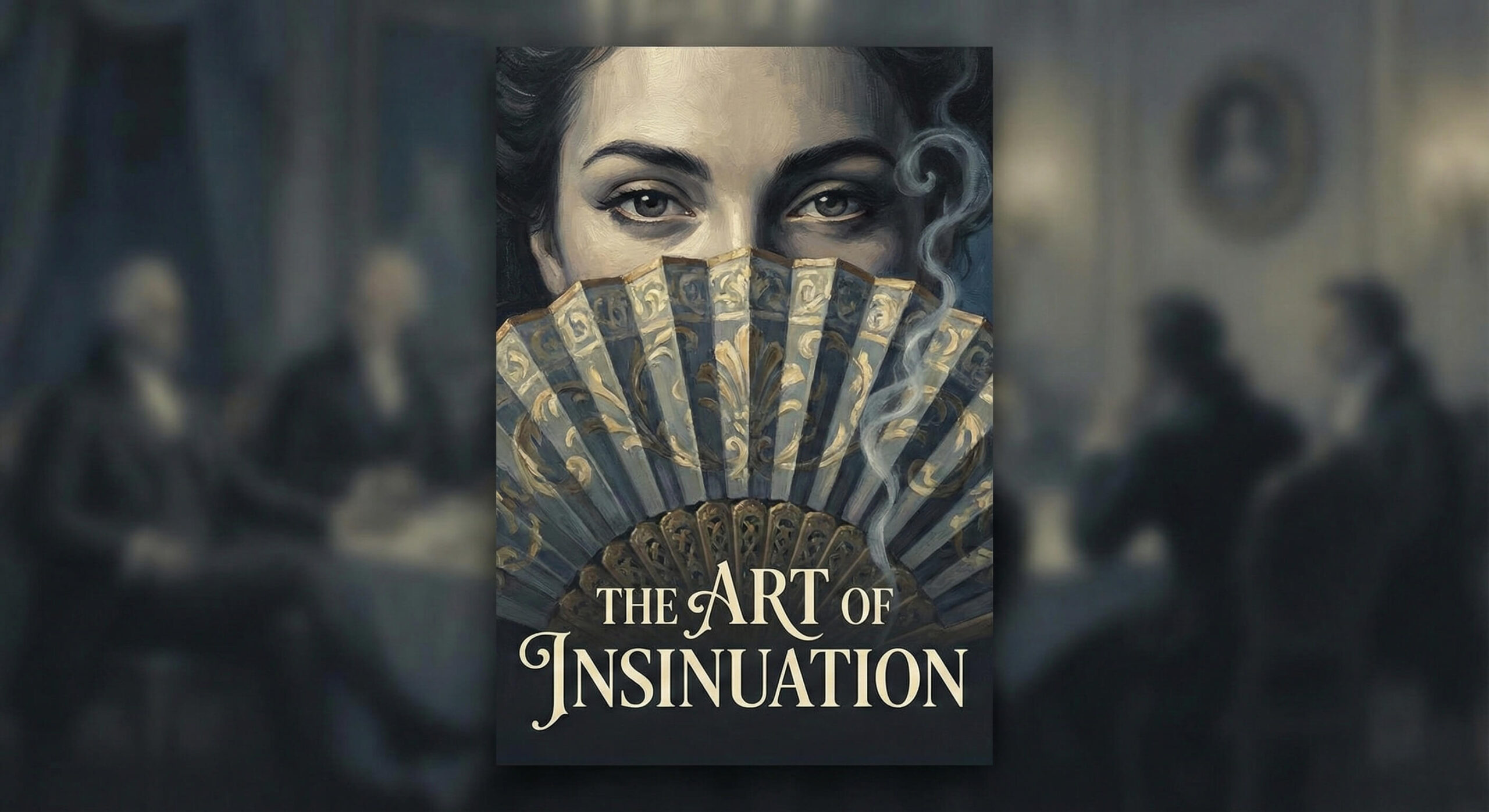
In an age of endless noise, blunt opinions, and oversharing, we often forget that the most powerful form of communication is found in the things we don’t say. True influence isn’t about hammering a point home; it is about the delicate dance of suggestion, where hints, implications, and ambiguities are far more persuasive than explicit words.
From the salons of 18th century France, where Madame de Pompadour navigated palace intrigue with a smile and a nod , to the modern boardroom, the ability to say less, and mean more, is a skill that elevates personal and professional relationships. Whether through artful insinuation, perfectly timed sarcasm, or the strategic use of silence, mastering the unspoken gives you control, allowing you to shape how others think without ever forcing your point.
Insinuation: The Art of the Unsaid
At its core, insinuation is the art of implying meaning without fully committing to it. Unlike a direct statement, which leaves no room for ambiguity, an insinuation is deliberately vague. It invites the listener to fill in the blanks, often leading them to a conclusion you wanted them to reach all along.
History is filled with masters of this craft. Queen Elizabeth I, for example, used the subtle power of insinuation to keep foreign suitors, and their armies, at bay. By sending letters filled with polite ambiguity, never fully rejecting marriage proposals but never accepting them, she maintained England’s independence and kept powerful enemies paralyzed by hope.
In everyday life, insinuation allows you to navigate tricky situations with finesse. Instead of telling a colleague their idea is bad, you might say, “That’s an interesting approach, I wonder if we’ve considered all the potential challenges?”. You haven’t rejected the idea, but you’ve planted a seed of doubt, all while maintaining plausible deniability.
Innuendo and the Double Entendre
If insinuation is the subtle guide, innuendo is its playful, sly cousin. Innuendo thrives on double meanings, allowing a single statement to carry an innocent message on the surface and a hidden, often risqué or humorous one underneath.
This creates a “social dance” where the listener must connect the dots. When Shakespeare’s characters traded barbs, or when a modern coworker says, “If you keep working out like that, you might make the rest of us jealous,” they are engaging in a layer of communication that builds chemistry and rapport. The key to successful innuendo is plausible deniability; if the recipient takes offense, the speaker can always claim innocence.
However, there is a fine line between clever and crass. A well placed innuendo invites the other person to play along, whereas a poorly timed one can feel intrusive. The goal is always to leave room for interpretation, never forcing the double meaning.
The Sharp Edge: Sarcasm and Passive-Aggression
Sarcasm is the “wry cousin” of insinuation, a way of saying one thing but meaning the opposite. When wielded with wit, it can diffuse tension and expose absurdities. Winston Churchill was a master of this, once famously deflecting Lady Astor’s comment that she would poison his tea by replying, “If you were my wife, I’d drink it” . His sarcasm turned a hostile moment into a humorous victory.
In the workplace, lighthearted sarcasm can bond a team during stressful times, joking about “living at the office” can acknowledge shared hardship without sounding like a complaint. However, sarcasm is a double-edged sword. If used too often or too aggressively, it can alienate people and brand the speaker as a cynic.
Similarly, passive-aggression is a tool of control, often used to express frustration without engaging in direct conflict. Phrases like “I thought you knew” or “Must be nice to have so much free time” cloak criticism in polite language. While effective for venting displeasure while maintaining a veneer of civility, relying on it too heavily can erode trust and create toxic relationships.
The Power of Ambiguity and Deflection
There is a peculiar genius in ambiguity. Phrases like “We’ll see,” “That’s an option,” or “I’m not saying it’s a bad idea, but…” allow you to speak without locking yourself into a concrete position. This verbal smoke and mirrors gives you an exit strategy. If a plan fails, you can claim you never fully endorsed it; if it succeeds, you were open to it all along. This “plausible deniability” is essential in negotiation and politics, keeping options open and managing expectations.
When a conversation veers into uncomfortable territory, the skilled communicator uses deflection. This isn’t about ignoring the topic, but rather pivoting gracefully. By acknowledging a comment (“That’s an interesting point…”) and immediately bridging to a related but safer subject (“…which reminds me of…”), you can steer the narrative without the other person realizing they’ve been redirected.
Silence, Flattery, and Small Talk
Sometimes, the most effective way to communicate is to say nothing at all. Silence taps into the human instinct to fill gaps, creating tension that forces others to reveal more than they intended. A well-placed pause can command authority in a boardroom or create emotional resonance in a speech. In negotiations, silence after an offer can pressure the other side into making concessions.
Conversely, when we do speak, even “small talk” has a big impact. Far from being shallow, these casual exchanges release oxytocin and build the rapport necessary for deeper trust. And when we want to influence, flattery, even the insincere kind, works because humans are hardwired to crave approval. However, the “backhanded compliment” (e.g., “You’re so brave to wear that!”) allows one to deliver a subtle critique wrapped in praise, keeping the recipient off-balance.
Mastering the Unspoken
Mastering these tools, insinuation, silence, sarcasm, and ambiguity, requires emotional intelligence and a keen awareness of context. It is about understanding that directness is not always the most effective path.
By learning to imply rather than state, and to use the space between words to convey meaning, you engage others as active participants in the dialogue. They are forced to interpret, to wonder, and to connect the dots. In a world where everyone is shouting to be heard, the person who masters the art of the unspoken is the one who truly controls the conversation. After all, saying less isn’t just more, it’s everything.