
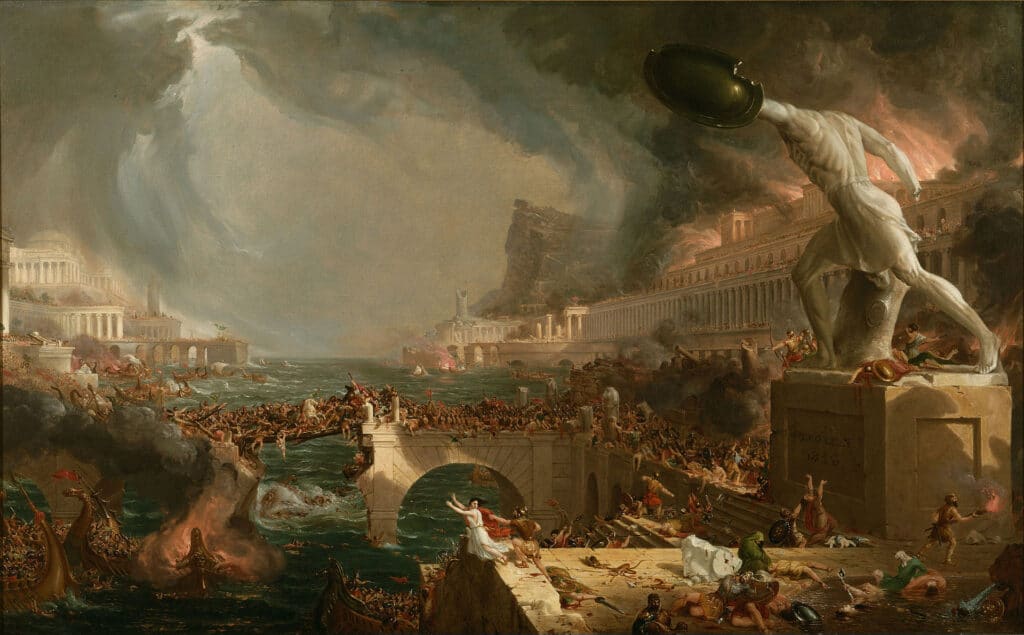
In the year 410 AD, the “Eternal City” of Rome was sacked, ending an era of invincibility and signaling the collapse of the greatest superpower the world had ever known. This event was not an isolated catastrophe but the culmination of gradual decline marked by economic turmoil, corruption, and overreach. History teaches us that empires, like stars, rise in brilliance before inevitably fading into the backdrop of time. Today, as geopolitical plates shift and technology redefines power, we are witnessing the latest turn of this eternal cycle.
The Anatomy of Power and Decline
Empires are not born overnight; they are constructed through a combination of military conquest, strategic alliances, financial systems, and unifying ideologies. Rome, for instance, mastered the integration of conquered peoples through citizenship, turning enemies into partners. Similarly, the British Empire built its dominance on global trade and the control of currency, with the pound sterling acting as the world’s reserve.
However, the very forces that drive an empire’s ascent often sow the seeds of its destruction. Growth eventually mutates into overreach. As territories become too vast to govern and military commitments stretch resources thin, the cost of maintaining dominance begins to outweigh the benefits. This pattern is evident from the Persian Empire’s struggle with diverse populations to the United States’ immense expenditures on global military presence.
Financial fragility frequently accompanies this overreach. Rome debased its currency to fund its legions, while the modern United States faces questions regarding the sustainability of its national debt. When an empire can no longer finance its ambitions without compromising its economic stability, it enters a twilight phase where internal decay invites external challenge.
The Rise of the New Challengers
In the 21st century, the unipolar moment of the United States is fading, giving way to a multipolar world. China has emerged as a formidable challenger, utilizing “debt diplomacy” and infrastructure projects like the Belt and Road Initiative to build a web of global influence without traditional military conquest. By financing ports and railways in developing nations, China creates dependency, echoing the resource extraction models of past empires.
Alongside China, the BRICS nations (Brazil, Russia, India, China, and South Africa) are working to reshape global governance. By establishing alternatives to Western led institutions like the IMF, they seek to dilute the power of the U.S. dollar and democratize global financial power. This shift suggests the future will not be dominated by a single hegemon, but rather defined by competition among regional power centers.
The Invisible Empires: Capitalism and Technology
Beyond nation states, we must recognize the “invisible empire” of capitalism itself. Operating as a meta empire, capitalism connects nations through trade and finance, creating a system where multinational corporations often wield more influence than governments. Yet, even this system is evolving. We are witnessing the rise of “surveillance capitalism,” where tech giants extract data as a new currency, using AI to predict and control human behavior.
Artificial Intelligence serves as the engine for a new imperial age. It offers unprecedented efficiency but threatens to render vast segments of the human population economically redundant. As automation takes over labor, the social contract risks collapsing, potentially leading to population decline as the traditional economic incentives for family life erode. In this technocratic future, power belongs to those who control the algorithms.
The New Frontiers of Dominance
The empires of the future will be fought over in realms that transcend geography:
- The Quantum Empire: The race for quantum computing supremacy is the modern arms race. A nation that achieves quantum dominance could break modern encryption instantly, rendering global financial and military communications vulnerable. This would redefine sovereignty, as power shifts to those who control the subatomic realm.
- The Empire of Memory and Mind: Cognitive warfare has become a tool for colonization. Through social media algorithms and historical revisionism, modern powers manipulate collective memory and individual thought. The battleground is no longer land, but the mind itself.
- The Fragmented Empire: Decentralization technologies like cryptocurrencies and blockchain are challenging the state’s monopoly on money and governance. While this offers individual empowerment, it also facilitates the rise of “micro empires”, specialized entities that dominate niche sectors of the global economy without holding territory.
Conclusion
The story of empire is the story of humanity, our ambitions, triumphs, and ultimate failures. While specific nations rise and fall, the mechanisms of power endure and mutate. Whether we face a future of multipolar competition, corporate techno feudalism, or decentralized governance, one lesson remains clear: no power is immutable. The empires of tomorrow will not just conquer land; they will seek to harvest our data, shape our memories, and encode the very reality in which we live.